
Introduction
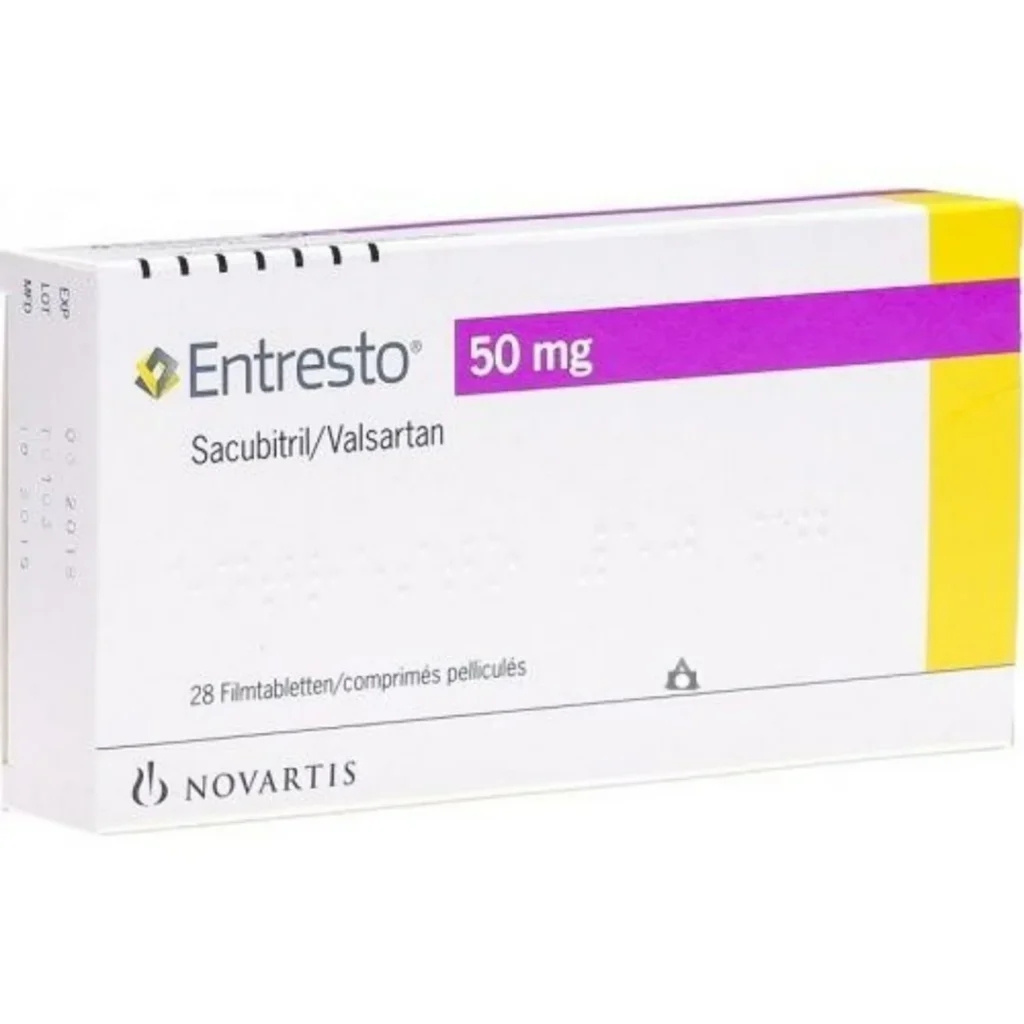
Entresto® is a combination drug consisting of sacubitril (a neprilysin inhibitor) and valsartan (an angiotensin II receptor blocker or ARB). It represents a breakthrough in the management of chronic heart failure (HF) with reduced ejection fraction (HFrEF), providing superior outcomes compared to traditional ACE inhibitors or ARBs alone.
Approved by the U.S. FDA in 2015, Entresto has become a first-line treatment in patients with symptomatic heart failure (NYHA class II–IV), aiming to improve survival, reduce hospitalizations, and enhance quality of life.
Pharmacology Overview
| Parameter | Sacubitril | Valsartan |
|---|---|---|
| Class | Neprilysin inhibitor | Angiotensin II receptor blocker |
| Mechanism | Inhibits neprilysin enzyme → increases natriuretic peptides, bradykinin, and adrenomedullin levels | Blocks angiotensin II type 1 receptor (AT1) → vasodilation, reduced aldosterone, decreased blood pressure |
| Bioavailability | ~60% (as active metabolite LBQ657) | ~25% |
| Protein Binding | 94–97% | 95% |
| Half-life | 11 hours (LBQ657) | 9 hours |
| Metabolism | Hepatic (esterase-mediated) | Minimal hepatic metabolism |
| Elimination | Renal (52–68%) and fecal | Biliary (83%) and renal (13%) |
Mechanism of Action
Entresto’s dual mechanism makes it unique:
- Sacubitril (Neprilysin Inhibitor)
- Neprilysin breaks down natriuretic peptides (ANP, BNP) and bradykinin.
- By inhibiting neprilysin, sacubitril increases these beneficial peptides, promoting vasodilation, natriuresis, and diuresis.
- Valsartan (ARB)
- Blocks the angiotensin II type-1 receptor (AT1R), preventing vasoconstriction, aldosterone release, and myocardial remodeling.
Together, the combination enhances cardiac output while reducing preload, afterload, and myocardial stress.
Pharmacodynamics
- Decreases systemic vascular resistance and cardiac filling pressure
- Increases stroke volume and ejection fraction
- Reduces cardiac remodeling and fibrosis
- Improves overall survival and symptom burden in heart failure patients
Clinical Indications
1. Heart Failure with Reduced Ejection Fraction (HFrEF)
- Primary indication: To reduce cardiovascular death and hospitalization in patients with chronic HFrEF (LVEF ≤ 40%).
- Recommended as first-line therapy (in place of ACE inhibitors/ARBs) in symptomatic patients.
2. Heart Failure with Preserved Ejection Fraction (HFpEF)
- Recent trials show benefit in reducing hospitalizations in HFpEF, though mortality benefit is modest.
3. Off-Label Uses
- Investigational use in hypertension and post-myocardial infarction remodeling, though not FDA-approved.
Dosage and Administration
| Patient Category | Initial Dose | Target Dose | Notes |
|---|---|---|---|
| Standard Adult Dose | 49/51 mg twice daily | 97/103 mg twice daily | Increase after 2–4 weeks as tolerated |
| ACE Inhibitor Switch | Start Entresto 36 hours after stopping ACE inhibitor | Avoid concurrent use | Prevents angioedema |
| ARB to Entresto | Start next scheduled dose | — | No washout needed |
| Severe Renal Impairment (eGFR <30) | 24/26 mg twice daily | Titrate cautiously | Monitor renal function |
| Moderate Hepatic Impairment | Start with lower dose | Avoid in severe hepatic failure | — |
Formulations available:
- 24/26 mg
- 49/51 mg
- 97/103 mg (sacubitril/valsartan) tablets
Administration Tips
- Can be taken with or without food.
- Do not crush or split tablets.
- Monitor blood pressure, renal function, and potassium levels during therapy.
Contraindications
- History of angioedema related to previous ACE inhibitor or ARB use
- Concomitant ACE inhibitor therapy (must wait 36 hours)
- Severe hepatic impairment
- Pregnancy (Category D – fetal toxicity risk)
- Hypersensitivity to sacubitril, valsartan, or excipients
Adverse Effects
| Common Side Effects | Frequency |
|---|---|
| Hypotension | 18–20% |
| Hyperkalemia | 12% |
| Dizziness | 8% |
| Renal impairment | 5–10% |
| Cough | 5% |
| Fatigue | 4% |
| Angioedema | <1% |
Serious Adverse Effects
- Symptomatic hypotension
- Angioedema (especially in Black patients)
- Acute kidney injury
- Severe hyperkalemia
Drug Interactions
| Drug Class | Interaction Effect |
|---|---|
| ACE inhibitors | Risk of angioedema (avoid) |
| Potassium-sparing diuretics (e.g., spironolactone) | Hyperkalemia |
| NSAIDs | Reduced renal function |
| Lithium | Toxicity due to decreased clearance |
| Aliskiren | Contraindicated in diabetes (risk of renal failure) |
Monitoring Parameters
- Blood pressure (especially during titration)
- Serum potassium (risk of hyperkalemia)
- Renal function (BUN/Cr)
- Signs of angioedema or hypotension
- Heart failure symptoms and ejection fraction
Clinical Efficacy and Trials
PARADIGM-HF Trial (NEJM, 2014)
- Compared Entresto vs Enalapril in 8,442 patients with HFrEF.
- Findings:
- 20% reduction in cardiovascular death
- 21% reduction in heart failure hospitalizations
- 16% reduction in all-cause mortality
PARAGON-HF Trial (2019)
- Tested Entresto in HFpEF patients.
- Showed reduced hospitalization risk, but primary mortality outcome not met.
PIONEER-HF and TRANSITION Trials
- Demonstrated safe initiation of Entresto during hospitalization for acute decompensated heart failure.
Pregnancy and Lactation
- Pregnancy: Contraindicated due to teratogenic effects from valsartan (fetal renal toxicity, skull hypoplasia).
- Lactation: Unknown if excreted in breast milk — discontinue nursing or the drug based on benefit-risk assessment.
Patient Counseling Information
- Do not take with ACE inhibitors — risk of angioedema.
- Report facial swelling, difficulty breathing, or fainting immediately.
- Avoid potassium supplements and salt substitutes.
- Stand up slowly to reduce orthostatic hypotension.
- Regularly monitor blood pressure and kidney function.
- Continue therapy even if symptoms improve — stopping suddenly may worsen heart failure.
Storage Conditions
- Store at 25°C (77°F), protected from moisture.
- Keep in the original blister pack until use.
Frequently Asked Questions (FAQs)
1. What is Entresto used for?
Entresto is used to treat chronic heart failure with reduced ejection fraction (HFrEF) to reduce the risk of cardiovascular death and hospitalization.
2. How does Entresto work?
It combines a neprilysin inhibitor (sacubitril) and an ARB (valsartan) to relax blood vessels, reduce fluid overload, and improve cardiac function.
3. How should Entresto be taken?
It is taken twice daily, with or without food, as prescribed by a doctor.
4. Can Entresto replace my ACE inhibitor?
Yes, but you must wait 36 hours after stopping the ACE inhibitor before starting Entresto to prevent angioedema.
5. What are the most common side effects?
Low blood pressure, dizziness, increased potassium, and kidney function changes.
6. Can Entresto be used during pregnancy?
No — it can harm the fetus and should not be used during pregnancy.
7. Does Entresto improve survival in heart failure?
Yes. In clinical trials, it reduced the risk of cardiovascular death and hospitalization compared to enalapril.